I Think I’m Addicted . . .

happiness pic

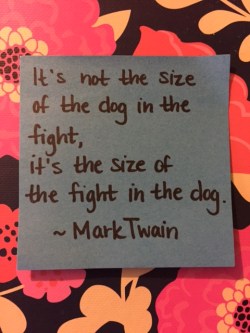
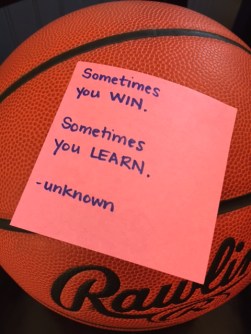
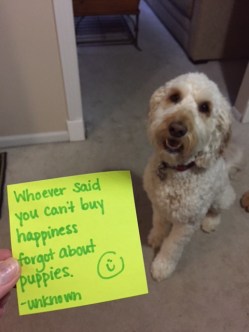
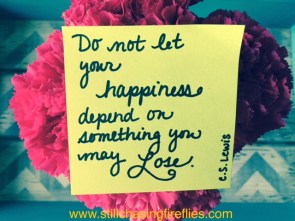
Hello, Friends!  I’m currently working on a Mother’s Day post (and about ten other posts that are awaiting attention), but there is something I wanted to share with you while those are under construction.  Remember this post about how to influence your kids when they think your advice is, well, so 1980’s?  I’ve heard from many of you in response to that post, and now I’m a bit obsessed with sharing some daily inspiration with YOU.  As much as I would love to blog every day, I can’t do it, but I can give you a few quick minutes of my mornings.  And who said the quotations I’m sharing are just for the kids?  I’m realizing that they brighten my own mornings and reaffirm my own values as I choose them each day.  Trust me; reaffirming your core values daily is VERY, VERY important.

I suggest that you take a few seconds to check the Still Chasing Fireflies FB page daily for a quick hit of wisdom.  Here’s a taste of what you will find from previous Still Chasing Fireflies FB posts.  Share the ones you love with your friends!  (And if you’ve been liking these on my personal page, hop over to the Still Chasing Fireflies one and make sure you have “liked” it so that I can post them in one place.)

Thanks for viewing the slideshow, and watch for that Mother’s Day post coming soon!

This slideshow requires JavaScript.

A Letter to My Son on His 13th Birthday

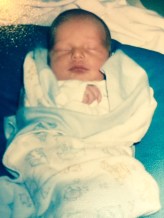
baby G

Dear Gavin,

Thirteen years ago today, you entered the world just a little sooner and a little more quickly than expected.  It seems like yesterday, and it seems like so many years ago, and the details are vivid and blurry at the same time.  I remember how you snuggled into a warm ball of folded limbs in my arms, how I studied every inch of you, from your fuzzy blonde hair to your teeny fingers and tiny toes.  I remember how you turned toward your daddy’s voice in those first moments, how we knew that you had been listening from the cozy cocoon where you had grown.  I remember how my anxieties melted away when I first held you, how I realized that mothering is both innate and mysterious, a bit frightening but surprisingly comfortable at the same time.   When you were born, my life, my purpose, my legacy – everything – it all changed.  I became a mother.

Before you were born, no one had ever depended on your dad and me for survival, so parenting was both exciting and intense.  The early days were messy and stinky and busy, exhausting and sometimes very long, yet the years have passed so quickly, like sparkling comets shooting through the sky.  I am in awe today as I look at you, a boy who is closer to being a man I have not met than to being the baby with corn silk hair who wrinkled his nose and squinted his eyes to make us laugh.  It is impossible to record all of those memories, all of the milestones and parties and vacations, the field trips and sporting events and spontaneous funny things that you have said.  But you should know that those memories are like jewels to me.  They are gems stored away in the treasure chest of my mind, riches that will not be broken or taken, buried or lost.

Gavin, things are changing between us, just as they are supposed to change, because you are growing up.  It is the sweetest and most difficult transition for a mom.  But you should know that your dad and I are incredibly proud of the young man you have become.  You are smart.  You are ambitious.  You are confident but humble, a leader but a team player, too.  You are a good friend, a caring grandson, a hard worker, and a young man of faith.  You aren’t afraid to stand up for what you believe.  You are funny and compassionate, sincere and loving and kind.  I don’t know exactly what you will do or who you will be five years from now, but I know that the path you are charting is GOOD.  I know that you will be a blessing to the world around you, and I know that you will reap many rewards in return.

I believe in you, Gavin.

But I am afraid for you, too.

It’s not that I don’t trust you or that I expect you to stumble at a fork in the road.  It’s just that I want to protect you, but I can’t always save you in the ways that I once could.  When you were younger, I could stop you before you ran into the street or grab your hand before you touched something hot.  I could redirect you before you risked just a little too much.  I could steer you toward the people whom I trusted to keep you safe.

But now you are in middle school, and you are meeting new people, people I don’t know, and your world is expanding beyond the fences I created.  You are facing problems that aren’t always visible to me, decisions that can change the trajectory of your life.  You are maturing, managing your own self, becoming your own amazing person, and it is heart-wrenching and incredible and agonizing and glorious all at the same time.

There are so many lessons that I want to share with you as you become a teenager, Gavin, lessons to tuck deep inside your soul so that they are not just things you know but things that are as much a part of who you are as your lungs and your freckles and your bones.  I want to talk to you about how “greatness” is so much more than what this world suggests.  About how failure is a part of living a full and meaningful life.  About how the people you spend time with will influence you, just as one cinnamon candy will flavor all the other candies in the dish.  About how you will always find what you are looking for, so look for the good, and about how happiness is a choice that you can make each and every day, whatever your circumstances.  About how the problems on the surface are rarely the problems that need fixed, so invest in scalpels rather than band-aids if you want to find your peace.

Maybe these are lessons for fourteen or fifteen or sixteen.  I’m not sure, Gavin, but let me teach you this.

I once believed that the moths that flutter around our porch lights were attracted by the glow, but scientists say this is not true.  They believe that moths navigate their course in the darkness of night by calibrating their flight against the position of the moon.  The moonlight is the moth’s touchstone, the constant that allows it to orient itself and fly in a straight line.  This is effective as long as the moth is not distracted from the moonlight, but the moth’s best instincts have been sabotaged by the glitter and gleam of artificial lights.  A moth that flies too close to a lightbulb or a flame becomes disoriented and loses track of the moon.  Its straight path deteriorates into a never-ending circle as it expends all of its energy, unable to get back on track.  Eventually, the lost moth becomes exhausted, often landing on and dying with its artificial moon.

When a moth loses sight of what will safely and steadily guide it, when it is distracted by something that is closer and brighter at that moment, it inadvertently creates its own demise.

Whatever you do, Gavin, do not lose sight of your touchstones.  They will guide you safely through the darkness until the sun rises once again.  Don’t exhaust yourself or lose your way by following something that shines just a little bit brighter than what you know to be true.

I try not to worry, Gavin, but it’s just a part of my job as a mom.  I fret about the test you have today and the track meet you have tomorrow, the college and career you will choose six years from now and the wife you will marry in a decade or more.  But I am confident that you will be ready for all of those things when they come.

I worry more that you will become distracted, that you will forget that this home, that our love for you, will always be a place where you can be safe and real in a world that will test you with its artificial glow.  This will always be the place where your truth can be rediscovered, where your bucket can be refilled, and where your spirit can find rest, even when you are all grown up.  This will always, always, always be your moon.

You are someone special, Gavin, and your dad and I are so lucky to have the privilege to walk the journey of your life with you.  I cannot wait to see the man, the husband, and the father that you will become.

But if you can slow down just a little, I will be fine with that, too.

Happy 13th.

Love Always,

Mom

mom and G crop

How to Influence Your Kids When They Keep Getting Smarter and You Keep Getting Dumber

Quote Intro

My kids think I’m stupid.

I knew this day would come.  I mean, I used to be that smartass kid myself.

I thought that I knew everything about everything because my age (almost) ended with -teen.  I thought I had the answers to life’s hard questions despite hardly having lived at all.  I thought my parents, who paid for everything and provided everything and fixed everything, were the least smart people on the entire planet.  And I had evidence.  I mean, I got straight A’s in middle school.  What could they possibly know that I didn’t?

(And then when I moved out, they studied really hard and became GENIUSES almost overnight!  I’m not sure why they waited so long . . . )

So now my kids are the ones rolling their eyes when I offer advice, sighing with distrust at everything I say.  How could my knowledge of unclogging a toilet or writing a check compare to their knowledge of sports stats and texting slang?  Seriously.

Yes, my kids think I’m stupid.

But here is something I have noticed.

They think Abraham Lincoln was smart.
They think Michael Jordan is smart.
They think the Beastie Boys are smart.
They think Dr. Seuss was smart.
They think Benjamin Franklin was smart.
They think John Cena is smart.
They think Yoda is smart.
They think Steven Spielberg is smart.
They think Albert Einstein was REALLY smart.
And they think Lebron James is a genius.

Basically, they think everyone is smart except me.

But here’s what they don’t understand: I AM smart.  I’m so smart that I can make them think I’m dumb while I’m outsmarting them.  I’m smart enough to realize that I can trick them into learning the values I want to teach them by teaching those values through someone else they trust.  Like Doc Brown from Back to the Future or Beverly from The Goldbergs.

Dumb parents everywhere, listen up.  Let me share with you my little secret – the Quote of the Day.

image7

Every morning, before my kids head off to school, I scour the Internet for a quotation that feels right for the day.  Sometimes it shares deep wisdom about life, friendship, hard work, perseverance, love, joy, faith, or success.  Sometimes it’s funny.  Sometimes it is a line from a movie we just watched or from a favorite television show.  Every once in a while it is a Bible verse, and sometimes it specifically applies to something that is happening that day, like if my kids need encouragement for a test or a track meet.  The quotation for the day is quickly recorded on two post-it notes, three if I want to be reminded of it later myself, and stuffed into lunch boxes before the kids dash out the door.  If one of my kiddos is buying lunch, then I stick the post-it somewhere in a folder or book for them to find later in the day.

image2

I know what you’re thinking.  Her kids don’t read those things.  They probably toss them in the cafeteria trash can or hide them under an apple or granola bar so that no one else will see.  How embarrassing.

WRONG.

How do I know this?  Because whenever I forget to pack one, they ALWAYS tell me.

Sometimes we talk about them over dinner.  Sometimes we don’t.  Sometimes their friends ask to see them at lunch.  Sometimes my kids reflect on them on their own.  Sometimes I stick them on the refrigerator as a reminder, and sometimes we discuss them when we unpack their lunchboxes after school.  Sometimes I see one from several weeks ago tucked into a folder or marking a page in a book. Cha ching.  If they read it more than once before tossing it, that’s even better.

image5

I hope that sometimes those words of wisdom, not from their stupid mom but from someone brilliant, like Charles Barkley or Will Ferrell, change their day.  I hope that enough of those carefully chosen words over all the days and all the weeks and all the months of school will help to shape their lives.

Remember the days when you could stuff a sweet note into your child’s lunchbox, and he would treasure that little scrap of paper love all afternoon?  Once you hit the tweens, those days are over.  But don’t be fooled, moms and dads.  Your kids still appreciate your influence.  They still want to know that they are loved, even as their growing independence pulls them farther and farther away.

image6

They want your attention; they just don’t want a lipstick kiss from their mother on a heart-shaped napkin anymore.

Because, well, moms are dumb.

But it’s okay, mom.  You’ve got backup.  Because Homer Simpson is really, really smart.

image1

**Maybe you want to pilot a Quote of the Day routine with your kids in the last quarter of the school year.  Let me help!  I included a few quotations above to get you started!  Watch the Still Chasing Fireflies Facebook page for more each week!  If doing this in the morning seems overwhelming to you, make them all on the weekend instead.  Five minutes and you are finished!**


Bleed

“There is nothing to writing,” Ernest Hemingway once said.  “All you do is sit down at a typewriter and bleed.”

Ernest was right.  Sometimes when you pull up a chair and your fingers stroke the keys, you spring a leak, and the things hidden inside of you seep out.  They bleed onto the page or into the air, and the blood is words, and sometimes when a soul starts bleeding it is hard to plug the hole.  Sometimes the words are a confession and sometimes they are laughter and sometimes they are heartache and sometimes they are love.

typewriter-and-bleed

Like blood, words give life to the thoughts and emotions swirling within us.  And the blood that leaks out when we write or we speak, those words, they have incredible power.

My words.  Your words.  ALL words.

Just think.  A writer can sit down with a blank sheet of paper that costs no more than a penny.

blank-paper

And that writer can add some ink, also nearly worthless on its own.  And then that little bit of ink sprouts into lines that stretch into letters that bloom into words.  And those words, when nurtured, flourish and grow and burst across the page.

Now those words – recorded in that ink on that worthless piece of paper – hold the potential to change a person’s day.  Or a person’s goals.  Or a person’s life.  Those words, although it may seem crazy, have the potential to change the entire freaking world.

This week my students will read “Letter from Birmingham Jail,” arguably one of the best examples of effective argumentation, written from a jail cell after Martin Luther King Jr. was arrested for peacefully protesting for civil rights in 1963.  His passion, in the form of words, bled onto napkins and toilet paper and anything else he could find in that jail, and those words continue to move us half a century later.  Just think about that.  A little bit of ink that seeped onto cheap toilet paper in a cold jail cell resonated with people around the world and awakened the social conscience of a nation.

Wow.  Our words have power.

Words can be persuasive, transformative, inspiring.  They can heal broken places or break what was whole.  They can become contagious and quickly race around the globe.  They can penetrate social and cultural divides with ease.  They can provoke reflection and conversations that change the way we think about ourselves and our purpose and our world.  They can excavate feelings that were deeply buried, brushing the dust off our frustrations and dreams, exposing hidden sadness and unseen joys to the brilliant light of day.

Words, when precise and controlled, can evoke feelings with an intensity that makes the page feel like reality and reality feel like the dream.  Ink can be tamed just as a wild horse can be broken.  A person can say things that change people and write things that make a difference.

You might think that only professional writers can harness the power of words.

But you are wrong.

Think of the power of these very simple words at your command:

I love you.  I like you.  I enjoy you.  I trust you.  I miss you.

I messed up.   I hurt you.   I’m sorry.  I regret my decision.  I am sad when you are sad.  I want to fix this.

I did not know. 

I believe in grace.  I believe in you.  I believe in us.  I forgive you.

I am alone.  I can’t do this. I  am empty.  I need help.  I need you.

I am on my way.  I am here.  I am with you.  I am for you.  I have your back.

words-are-your-power

I will fight for you. 

I will help you.  I will stay with you.  I am always on your team.  I will protect you.

I pray for you.  I hurt with you.  I have felt this, too.  I understand. 

I don’t understand, but I care about you.

I admire you.  I respect you.  I am proud of you.  I appreciate you.  I am thankful for you.

I see you.  I hear you.  I know your heart.  I am listening. 

I promise.

I can and I will.  I will tell you the truth.  I will give you my share.  I am thinking about you.  I see your beauty.

I am better because of you.  I want to be like you.  I treasure your advice.  I value your ideas. 

I don’t agree with you, but I still love you.

I am not perfect.  I am no better.  I am glad you are my friend.  I can do hard things with you.  I see your courage.

I am happy when you are happy.  I love to see you smile.  I cherish my time with you.  I do not deserve what I have been given. 

I can’t imagine a better friend.

I choose you.

When you feel powerless, remember that you have words.

When you want your relationships to grow, remember that you have words.

When you want to make a difference in your life, your home, your family, your neighborhood, your world, remember that you have words.

So find blank pages and some ink.  Breathe life into them.  Harness the emotions and ideas that are swirling within.  Let the words that are hidden inside you begin to leak out.

Your words are your power.  Never forget this.

Ready.  Set.

BLEED.

regret

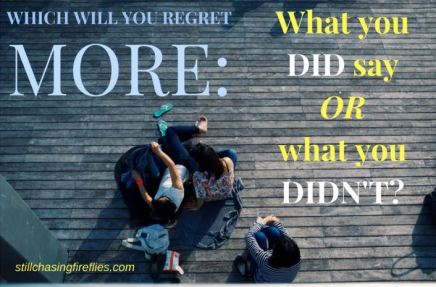
Hey, fireflies!  Thanks for reading this post about the power of words.  I hope you enjoyed it, but my greater hope is that it inspires you to take fifteen minutes out of your week and write meaningful notes to a few of the people in your life.  Maybe there is someone who deserves your thanks or someone who needs you to make something right.  Maybe there is someone who does not know how much impact he or she has had on your decisions.  Maybe there is an adult who needs your encouragement or a child who needs your love.  There are so many possibilities!  You may be surprised by the doors that open when you let what is on the inside leak out!  I challenge you to write three notes this week, and then come back and let us know what you did and how you felt!  Thanks for reading, friends!   ~Mary Ann


I’m Not Sure How to Mom Anymore

sports

I.

I have two sons.  In just a month, they will be 11 and 13.  And our home, well, it’s not the same as it used to be.  There are basketballs and gym shoes, shin guards and dirty socks at every turn.  There is a constant search for missing earbuds and phone chargers, and “pump up” music, the kind that plays before sporting events, has become the soundtrack of our lives.  There is a funky smell here, a mingling of stinky shoe, sweaty uniform, and Axe body wash, that wafts through the air.  And it is next to impossible to keep snacks stocked in the cabinets.  Almost-teen boys are a lot less snips and snails and puppy dog tails and a lot more bottomless stomach.

I don’t mind wrangling the socks and washing the uniforms, and I’m learning to hide my favorite snacks from the scavengers who live here.  I know to watch for loose balls at the bottom of the stairs, and I’m an expert at hunting for “lost” equipment as we are running late to practice, again.  I don’t even mind the stinky smell.  I mean, I don’t like the stinky smell, but I’m becoming desensitized.  And my mother-in-law buys me candles, so that helps.

What I do mind is that these simple, insignificant changes signal something bigger, a shift in my responsibilities as a parent, a change in what motherhood means.  The canary that represents childhood at our house is barely hanging onto its perch.  I’ve been trying to resuscitate it, but it isn’t working, and the thought of a dead canary here nearly stops my heart from beating, too.

My little boys aren’t so little now, and I don’t really know what I’m doing.  I’m not sure I know how to mom anymore.

I was skilled at rocking my sleeping babies.
I was quick at chasing my busy toddlers.
I was smart at exploring the woods with my curious preschoolers.
I was impressive at creating crafts and experiments for my kindergarteners.
I was even good at teaching my inquisitive elementary students to read.

But I don’t know how to parent 10 and 12.


II.

A few weeks before Christmas, my younger son begged me to chaperone his concert rehearsal for fifth- and sixth-graders who play strings.  He pleaded with me several times, and I changed the subject several times, mostly because missing work usually creates more work for me in one way or another.  But he persisted, and the teacher sent out a code red that said something like “We are in need of chaperones” but that sounded to me like “These kids will never amount to anything if none of their mothers even care, for goodness sakes.”  And also I realized that my little boy is 10, and he was begging me to go, and in just a few short months he may be begging me NOT to.

So I signed up.

On the morning of the rehearsal, I was excited to spend a little extra time with my son.  I waited in the office until the secretary released the students for the trip and boys and girls rushed into the hallway with music books and backpacks and violins.  I hurried to the bus to welcome them and watched through the window as my son and his friends approached.  Soon he boarded, giggling and chatting with his classmates, who quickly shuffled past my row to claim the seats in the back.

He may have said hi as he passed by.

I’m not exactly sure.

But I am sure that there was no hug, no I’m-so-glad-you’re-here-Mom, not even a pause for a chat or a fist bump.  There was nothing, really, to indicate that the two of us were any more related than any other pair of people on that bus.

The rehearsal went off without a hitch, and soon we were boarding again to head back to the elementary school.  On the return trip, I glanced behind me every once in a while to see what was happening in the seats in the rear.  The kids talked and joked and laughed and enjoyed escaping the classroom for an hour or two.  When the bus doors opened once again, the students hastily exited to return to class.  And the kid who had begged me to chaperone this trip scurried down the hallway without ever looking back.

And that was that.

My dog wagged her tail and jumped excitedly when I got home, which soothed my fear that I had turned invisible after leaving the house in the morning.  I checked the mirror and pinched myself just to be sure.

Yep.  I’m still here.

Later that evening, to my surprise, my ten-year-old thanked me for going on the field trip “with” him.  He was so happy that I had taken a few hours off work to ride that bus, even though it had seemed like my presence didn’t matter at all.  The truth was that he never intended to spend time with me on the way to his rehearsal.  He just wanted to know that, when given two choices, I would choose him.

Thank goodness I did.  Because I came very close to failing that test. 

I may have felt a bit neglected that morning, but I knew exactly where to sit at the concert that night for a perfect view of my son and his cello.

So there’s that, too.

This is what parenting 10 looks like.


III.

Last Friday, my older son’s middle school basketball team was recognized during half-time of the varsity game at the high school.  It was a big deal to us.  But as we finalized our plans for the evening, he seemed unexpectedly stressed.

“Mom,” he said, looking conflicted, “you can just drop me off at the high school.  I mean, if you want to, that’s fine.”

Drop him off?  Was this kid serious?

This was going to be a sweet moment.  I mean, he was wearing a freaking bow tie, and they were announcing his name, you know, over the loud speaker.  In front of a big crowd.  At a varsity basketball game.

No, drop off is not an option.   

“Okay, yeah, well, I really want you to be there, Mom.”

Yes . . . I know that. . . So what am I missing?

“But it’s okay if I hang out with my team, right?  You won’t care, will you?”

Oooooooooooohhhhhhhhhhh.

Of courseYour team.  Right.  Your friends.  For sure.  Absolutely.  I mean, that will be perfect because I really just wanted to concentrate on the game anyway. 

Yeah.

So my son played it cool with his teammates while I sat alone in a gym packed with people since the rest of the family had other things to do.  It was different.  But I enjoyed observing my son from a distance, seeing the whole picture of who he is without the distraction of the details.  I enjoyed watching how he interacted with his friends and  admiring the young man he has become.  I know I’m his mom, but, really, that kid is pretty amazing.

I didn’t mind cheering for the home team while he socialized since I love watching basketball, too.   But I was shocked that night, because something about high school has definitely changed, and very recently, I think, because I have been teaching high school for thirteen years and I have never noticed.

Get ready for this.  Grab a chair because it’s crazy.  Ready?

High school boys LOOK JUST LIKE GROWNUP MEN now!

Seriously, when did this start happening?  And why aren’t we researching how to make this stop?

I looked at the players in disbelief, imagining what my grown sons will look like and wondering how ALL of those changes can possibly happen in the next few years.  It seems impossible.  Glimpses of the future flashed through my mind, tempered by glimpses of the past, when I was cheering from the student section and my husband was the high school basketball player and everyone loitered at Burger King or ran through the Taco Bell drive thru after the game.

Time is not a distance runner.  He is a sprinter.  He races past at an incredible speed.  Kids grow up, and adults get old, and moments pass quickly and are lost forever.  Our only hope of bottling yesterday is to preserve its memories.  And that only works if we take time to make them.

While we were at the high school that night, my son touched base with me only once.

Yes, when he needed money.

But on our way home, he talked and talked and talked about the events of the evening and the conversation he had with a former coach and the funny things that happened with his friends.  And the two of us decided to run through Taco Bell, just like my friends and I did in high school, even though we had already eaten dinner, even though it was after ten o’clock at night.

I wonder if, ten years from now, he will remember eating those tacos with his mom after a varsity basketball game in 2017.

I hope that he will.

This is what parenting 12 looks like.


IV.

When I started teaching, I worked at a rural high school in southeastern Ohio with a man named Jim Williams.  Jim Williams was tall and serious and a respected veteran teacher.  He had a dry sense of humor and a quick wit, and it seemed to me that he had read every piece of literature that had ever been written.  He was also the chair of the English department, so he was, at least in my mind, my boss.

I was a novice, still learning the ropes and finding my confidence, and Jim Williams was never anything but kind to me when I worked with him.  But, because of my own insecurities as a young teacher, I felt about fifteen years old whenever we spoke.  My mind defaulted from being the high school teacher to being just another student, although he always treated me as a respected colleague.

So Jim Williams and I didn’t chat very often, mostly because I was more comfortable feeling my real age of twenty-something than defaulting to an anxious fifteen.  When I needed professional advice, he was helpful, but I didn’t hang around long enough to discuss the news or the weather or my life outside of school.  The English wing had no extra room for me, so I could easily escape to my classroom by the gym with any seeds of wisdom he had shared.

In hindsight, I should have devoted more time to learning from Jim Williams than to hiding from him because he shared some of the best advice that I have ever been given.

And it had nothing to do with teaching.

It was a gloomy winter day at the high school when I received a message that my baby boy was sick and I would need to be home for the next couple of days.  Not only was I striving to excel as a teacher at that time, but I was also just learning to juggle the demands of teaching and motherhood.  Before having a baby, I rarely used a sick day, and I often continued working after school until late into the evening.  I took pride in my commitment and my creativity and all of the extra hours that I logged.  I don’t remember exactly what I said to Jim Williams that day, but I imagine that it was some version of an apology for needing to be home.

What I do remember clearly is that he stopped me – so that he could say something profound instead of listening to my nonsense.

Jim Williams said, “There will always be another teacher, Mary Ann.”

Oooooooh.  That burns.  I mean, I’ve been trying really hard to be the best and to do the most and to keep all the plates spinning.  You haven’t even noticed?

He wasn’t finished.

“There will always be another teacher, Mary Ann, but your son will never have another mother.”

See.  I told you he was smart.

Yes, it stung, but I understood what Jim Williams was saying.  He wasn’t telling me that I was easily replaceable or that my teaching wasn’t up to his expectations.  He wasn’t saying that hiring a substitute for a day or two would be equal to my presence in the classroom.  But he was telling me to take a deep breath and prioritize.  And I needed that.  Because sometimes I was so worried about being the best teacher for my students that I wasn’t being the best mother for my baby, even when I was at home with him at night.

Jim Williams was saying that my presence as a mother matters.

And I have never forgotten that.


V.

Maybe raising 10 and 12 isn’t as complicated as I think it is.  Maybe it’s mostly about presence, about “choosing” the people we love and connecting with them whenever and however we can.  Maybe it’s as simple as being in the same place, even when we are all in separate rooms doing separate things.  Maybe it’s just about being.  Maybe just being is exactly what my sons need.

Don’t get me wrong.  We eat dinner as a family and play games together.  We plan fun events and talk and spend time with grandparents and friends.  Those things are important.

But there are many more hours now when I am not chasing anyone or disciplining anyone or teaching anyone about fractions or saving anyone from harm.

There are many more hours now when I am just here.

And that’s okay.

Maybe parenting 10 and 12 is being close enough to come to the rescue but far enough away to let my children take a chance.  Maybe it’s watching them climb the tall, scary ladder, and then holding the safety net under the tightrope they are walking to become men.

The minutes, they pass quickly, and there is no buying them back when the canary’s song fades.  So maybe I just need to relax, enjoy the journey, and remember that just being matters.

And maybe it matters the most when it seems like it doesn’t matter at all.


Image Source: Steven Depolo under Creative Commons Attribution 2.0 Generic
 

What It Feels Like to be the White Mother of Black Sons

Rikki

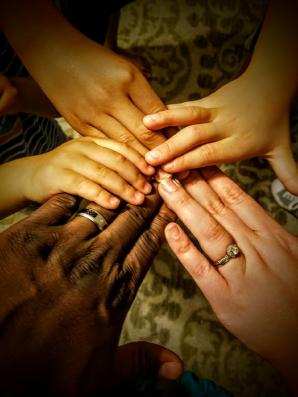
My heart has been hurting, friends.  The world has been spinning out of control recently, and I keep thinking, “Why won’t all of us just listen to one another?  Why don’t we seek understanding instead of taking sides when we all want the same things – to be respected, to be safe, and to be treated fairly?  Why can’t we acknowledge the pain in another person’s heart and help to heal it?”

Then I read a Facebook post written by my friend and coworker, Rikki Johnson, and I was so moved that I asked her if she would adapt her post for our “What It Feels Like Series” here on Still Chasing Fireflies.  I am incredibly thankful that she agreed to open her heart to us in this way.  I know Rikki as an enthusiastic English teacher, but she and I have another thing in common: We are both moms of boys.  Our boys don’t have the same racial heritage, but her essay reminds us that ALL mothers share the same heart, and this is a way that we can connect and understand one another, even when our life experiences may not be the same.  As a mother of black children, Rikki worries about some things that I hadn’t even thought about before.  Her essay challenged me.

PLEASE read Rikki’s story.  Please read it with an open heart and mind and share it with your friends and family if you are moved, too.  That is one small way that you can be a bright light in the darkness, just like a firefly, as we all seek to be understood.

I’ve remained pretty silent lately regarding the recent incidences of the two unarmed black men murdered at the hands of police officers, as well as the murders and shootings of the Dallas police officers. I’ll start with this: it is a difficult time in our country to be a police officer. The murders of those men protecting the crowd in Dallas is despicable and it only overshadows the message so many are trying to peacefully spread. Think of this though: the distrust, disrespect, and criticism of the police these days is very similar to the reality that black men have faced as a whole throughout our country’s history.

My recent silence on this issue mostly stems from fear. I’m afraid of being disappointed in the reactions to my feelings about this by those closest to me and my boys: my family and friends. I hold so many people to such high expectations that I usually set myself up to get my feelings hurt when they don’t live up to them. I’m begging you to see my perspective and try to understand where I’m coming from. I am a white woman married to a black man, and I’m raising black sons.

So many people hold my children and husband as a separate entity than my neighbors’ black husband and children because I am white. My family is an example that I know many of my friends and family members use to justify their perception that racism is no longer an issue. My husband is used as an example that “good” black men do exist. But if my husband were caught making the same mistakes as many of my white family and friends have done, would he still be one of the “good” ones? What if one of my boys were caught shoplifting a candy bar or some other youthful antic like toilet papering someone’s house or breaking curfew? Would you label him a thug behind our backs?

Why don’t you listen when my husband openly speaks about his personal experience being black in this country?  Why don’t you listen to me when I try to explain that my husband and boys, yes, even the “good ones,” are statistically 2.5 times more likely to be murdered at the hands of police. And if they are, someone, somewhere, will try to find some past record, social media post, or picture to justify why they somehow deserved it. Heaven forbid, if my son were to ever make a mistake and be subjected to the legal system, he would be more likely to receive a stiffer penalty than a white man who made the same mistake. How many times do you get pulled over in a year? My husband was pulled over 6 times in the last 12 months while driving home through the predominantly white city where he works. Some of his driving infractions: failure to signal, failure to come to a complete stop at an empty intersection, and going 40 in a 35. Most of those times, he was sent on his way after they ran his license, insurance, and plates. Maybe it was his nursing scrubs that eased the officers’ minds that he was a “good one?” In cities across the country, black people are disproportionately pulled over for minor driving infractions compared to white people. They are also 2 times more likely to be subjected to being searched.  These are facts, and my husband and boys are not any more immune to them than the next black man down the street.

If you love us, then listen please. Please stop trying to explain away our experience as a family or my fears for my husband or my boys because it makes you uncomfortable. This is our reality, and just because you don’t understand it doesn’t mean it doesn’t exist. These problems remain because people keep trying to explain them away or debate them or say that others are only trying to stir the pot. We all know that not talking about a problem doesn’t make it go away. Listen to what people are saying instead of just waiting for your turn to speak. Try to put yourself in the other person’s shoes and remember that just because something isn’t a part of your experience, it doesn’t mean it doesn’t exist.

I’m not sorry for being born white. I’m not ashamed of who I am at all. I’m comfortable being me around any person, and I always have been. But, as a white person, I recognize the privilege that comes with it. Growing up, I didn’t know fear in interacting with police. I never wondered if I were overlooked for a job because of my skin. I was never followed through stores by associates when I was out shopping with my friends. I’m mouthy and sarcastic, and I see how differently my demeanor could be perceived if I were a black woman exhibiting the same behavior. Recognizing this privilege doesn’t mean you are ashamed to be white. Acknowledging an issue is the first step in making changes.

It is scientifically proven that young black boys are perceived to be older than they actually are upon first glance than white boys. This means that higher expectations for their behavior are placed upon them at a younger age. When black boys play rough, their behavior is more likely to be deemed violent and malicious, whereas white boys are considered tough and masculine. Boys will be boys, you see. In a study testing even the subconscious perceptions of participants, adult black males were perceived as more of a threat than their white counterparts. My eldest is about to turn 12; day by day he is turning into a man and statistically is perceived as more threatening. Maybe his predicted short stature will protect him? These are the things that I think about that mothers of white children don’t.

As any good parent should, I’ve raised my children to address authority figures, such as police, with respect. But, as a mother of black boys, I have to go deeper than that. We have to practice what to say, how to say it, where to put your hands, never to move without explaining your actions, how to appear small and unthreatening. I have to remind my boys as they grow into men outside of my umbrella of protection that they shouldn’t run down the street, even if they’re in a hurry or running late. They shouldn’t wear a hoodie over their heads, or travel in large groups of other black boys. All of these actions could invoke suspicion or draw unwanted attention. Maybe I’m wrong, but I don’t think any of my friends and family members with white boys ever had to go through training as extensive as this just to leave the house! And, yet, it could not even matter because last week a man did everything right when stopped and was still murdered right in front of his 4 year old and wife.

I know many of you will not have even read this far. Or, if you have, you may have been coming up with rebuttals to each of my points along the way. I’m not asking to debate. I’m trying to let you in on my reality as a wife and mother. My hopes and dreams for my babies and their futures are no different than any mother of any color. I dream that my children will lead successful, productive lives. I want them to become great fathers, husbands, friends, employees just the same as any mother wishes for her sons. However, these ongoing incidences of violence and injustice serve as constant reminders that nothing, not even my children’s lives, are promised.

To my family and friends, I beg you not to claim you love my boys and my husband, and yet still try to justify all these other men being killed for being black. My perspective–my husband’s perspective–my beautiful children’s perspectives are very similar to those of the people who are marching in the streets to end this violence on ALL sides. We’re not against police and we’re not calling anyone racist. We’re asking that you at least acknowledge the problem and find some understanding and support to help make this country better and safer for my family and yours.

Thanks again to my friend Rikki Johnson for sharing her “What It Feels Like” story with us.  Speaking out in the midst of controversy is not easy.  It is courageous, and it is important.  Starting conversations and then listening with love, respect, and patience is important, too.  Thanks, Rikki, for being loving and patient with me as we discussed some really hard things.

Do you have a life experience that you can help other people understand?  It could be ANYTHING that is stirring your heart!  You can write it yourself, or I can help!  Please reach out to me to add to our “What It Feels Like” series!


What It Feels Like to be the Son of a Father With Dementia

what it feels like

Grab a tissue, my friends.  I swear that my goal at Still Chasing Fireflies is not to toy with your emotions, but this What It Feels Like series is definitely going to bring out ALL the feels.  Last week, my husband and I were hundreds of miles apart while he was in Chicago for work and I was visiting family.  When we finally reunited, he dropped a bomb on me; he had been secretly writing this beautiful post about how it feels for him to watch his own father battle dementia.  Oh. My. Goodness.  I could hardly edit and post this on the blog through my tears. 

Love on your dads, people.  Please.  Now.  Do not wait.

Like many other young children growing up, I believed my father was one of the strongest, smartest, goofiest, hardest working men I knew. He could do, and fix, anything. But those qualities weren’t always the ones that meant something to me as a child.  I valued when he would get on the ground and wrestle with me.  I still remember the feeling of his scruffy face once in a while and how he would use that as a laughter-drawing weapon on me during the match.  

I remember how he would sit and work out floor plans for houses and buildings using my architectural building blocks on our end table in the family room.  He taught me what lintels, copings, rough openings, and many other construction terms meant, simply by playing with me and those blocks.

I recall him being excited to show me his design for our club house, walking me through the drawings and dimensions. I should note that my passion for construction and design began at a very early age, and my father played a critical part in that. Not sure he meant for that to happen, but he seemed to enjoy that I liked it.

As time moved on, he and I worked on my first car together, having the carburetor rebuilt so we could replace it, hoping it would help me get something more than 10 miles per gallon.  (It’s a good thing gas was .95 cents per gallon then; I didn’t want to spend all my paper route money on gas because I needed some for actual dates!)  I probably wasn’t the best mechanic, and I am sure I complained about holding the light for him more than doing any actual work myself.  But we got the job done.

That was also about the time my father invested in the family boat, well, Jon Boat that is, for fishing.  I had the pleasure of being one of the first passengers during the initial shove off from shore, and, well, it floated.  And that…was…about…it. Many minutes later, we finally got the motor fired and we were off.  Off to find the catch of the day. Or, in my case, to put my favorite mix tape in my Walkman and catch some rays.  You see, fishing was something my father and I didn’t have in common.  He enjoyed the outdoors, and, well, I enjoyed the cities.  

And so the distance between us grew.

It was close to the end of my senior year, just a few more weeks remaining in my basketball season, when I came home from practice to find my father in the driveway washing the family car.  For anyone else, this may have seemed perfectly normal.  But not for my father.  You see, my father worked the 4 to midnight shift most of my life.  He was either sleeping or working when I was home.  On this day, for him to be home at this time didn’t add up.  And it wasn’t good.  He had lost his job at the age of 54, just shy of age 55 – the age when he would have been able to collect his full pension.  This was the mid 90’s, before age discrimination was something to litigate. This event was crushing for the family.  With a wedding for my sister that summer and my desire to go to college, and without another full-time income in our home, life was about to get difficult.

However, that moment in time changed everything for me.  Watching my dad handle the issue with integrity and seeing him take on anything and everything to keep food on the table taught me to do the same.  But it also drove me to focus. I knew I was going to spend the rest of my life working hard and chasing my dreams, following my passions, and living the life I want.  

So after graduating from high school, I worked two jobs while attending a local community college to earn a degree and the credits necessary to transfer to a larger school.  After my first year at Kent State, I was accepted into their school of Architecture.  There was one caveat; I had to go back to Kent for Summer Studio immediately. The day I left for college was Father’s Day, 1997.  My father, who in my first 20 years rarely shed a tear in front of me, cried that day after commenting about me heading off to start the program and knowing I wasn’t going to be coming home for the summer.  I’m not completely sure if the tears were sadness or if they were happy tears because I was fulfilling my dreams, but it was a rare occasion either way.

There were many times during my college years that my father would talk to me about how he never really got to do what he wanted because he wasn’t that great in school.  He would end up working odd jobs during the semesters just to survive rather than studying.  I believe that he told me these stories to encourage me to never give up, to trek on and fight for everything I wanted to achieve.

So why am I telling you about these memories of my father and me?  Because he can’t, not anymore.  You see my father was diagnosed with dementia, and he sometimes forgets how many sons I have, or our names, or what I do for a living. He forgets where he is and why he is there, or if he has even eaten.

Watching this awful disease progress is like watching the sand on a beach fight the ocean tide. As the day passes, the memories of those footprints, sandcastles, motes, and all the fun experiences that occurred on the beach are erased.  With each new day, the experiences in the sand begin over.  There is no remembrance of what happened the day before.

My dad has memories, but they tend to be from further back in his life, not many from us as a young family. Mostly he reminisces about his days in Vietnam. And as the tide of his mind rises, and then regresses, the same stories begin again.  This happens many times during an hour.  So you sit, and listen to the same stories again, just so you can spend time with him.  Or you find yourself fielding the same questions, over and over again, trying with all your energy to stay relaxed and not show frustration at this horrible disease that is not his fault.  Often you find yourself fighting internally with the pure instinct to avoid the visits rather than see a man struggle with this relentless disease.

There are times when I am working on something at home and I am struggling or need help, and I think I should call my dad, like I use to, because I know he will know what to do.  But then I instantly realize that this isn’t a possibility anymore.  It hits you like a champion boxer just set you up for his patented left jab and right hook combo.  The man who could have done anything, who could have taught you anything, who was there to show you how, is no longer available for you in this capacity.

Sure, he is here, but not all of him.  You wish that you could call him and work on some projects in the yard or in the house together.  You wish that he enjoyed sports like you do, or that you liked fishing so that you could spend some time together doing things you both enjoy.  But most of all, you wish he could remember that he gave you some of your best qualities and made you who you are.   

This is what it is like being the son of father who has dementia.  You are not completely sure WHAT he remembers.  You are not sure IF he remembers.  You are not sure HOW MUCH he even knows about what is really happening to himself.

So I will add some gravel and Portland cement to the sand on my beach and set my memories in concrete for both of us, until one day those memories may very well erode away for me, too.  But until then, my father will always be the goofy, scruffy-faced wrestling superhero he has always been to me, preserved in my memory until the waves finally win the war.

Thanks again to my husband, Ryan Ware, for sharing this post with all of us.  It wasn’t easy to write, I am sure, but sharing our hard things can help others and maybe even heal whatever is hurting us, too.

Do you have a story to share in this series?  I think you do.  You don’t even have to write it yourself.  I can help!  Just let me know what’s on your mind.

Finally, it’s Father’s Day!  We love you, dads!  Happy Father’s Day to my own dad, Kenny, and to all the other dads out there, including my husband, my father-in-law, and my grandpa, too.   

Be sure to show your dad some love this week, and watch for the next post from Still Chasing Fireflies!


Why I Should Be in Jail and Other Things I Learned From the Tragedy at the Zoo

snake

When I heard about the little boy who had fallen into the gorilla enclosure in Cincinnati, I was fascinated just like everyone else.  Maybe it’s because I recall the hazards of raising two quick, mischievous preschoolers of my own just a few years ago.  Maybe it’s because we love animals or because we live so close to an amazing zoo that we spent many carefree hours there almost weekly when my boys were small.  Maybe it’s because we were at the zoo one day when a silverback rushed to the front of the enclosure and slammed his hand into the glass with such force that we all jumped in surprise.   Or maybe it’s because we just can’t wrap our heads around how these majestic creatures that seem so warm and gentle lounging in their artificial habitats have both the intelligence and the physical strength to break us in half.

Would meeting the friendly faces on the other side of the glass be more like a dream, or more like a nightmare?

After watching a few news stories and hearing the eyewitness accounts, I felt comfortable that I had the gist of the story figured out.  A mom was at the zoo with her child.  The mom looked away from her child for a brief moment, as parents sometimes do.  The child broke the rules, as children sometimes do.  The mom and I and all of America were horrified to discover that the child had fallen into the gorilla enclosure.  The gorilla acted like a gorilla, creating a dangerous situation for the child.  The zookeepers, unable to read the gorilla’s mind and having little time and a child’s life on the line, made a heartbreaking decision that will probably haunt them forever.  The child survived.  The loss of the gorilla was terribly tragic.  Everyone learned a lesson.  Life, as always, will move forward.

BUT THEN I started reading all of the commentaries.  I read one and then another and then another.  Each time that I finished reading one, a new one would pop up, and soon I realized just how naïve I had been to think that this incident was an isolated tragic accident, the devastating result of the perfect storm on what could have been an ordinary day at the zoo.  This incident was not about one little boy, one flawed enclosure, and one tragic loss.  There are so many lessons we can all learn.

  1. Zoos are a death trap.  Seriously.  Yes, I have been to the zoo probably 275 times in the past ten years.  My kids have gone to camp at the zoo and attended preschool right beside it.  No, we were never injured, nor do I know anyone who has accidentally or even purposely entered an animal enclosure without permission.  Yes, this child was the first and only child in 38 years to sneak into the gorilla pen at this particular zoo.  But these places are DANGEROUS, with a capital D, and a capital A-N-G-E-R-O-U-S, too.  Sure, they are marketed as safe places where kids are educated and entertained, but N to the O.  I now regret everything my children learned there and all of the wonderful memories that we made.   Totally not worth the risk.
  2. Children must be watched EVERY. SINGLE. SECOND.  Sure, we already knew that we need to watch our children carefully, but that’s not what we’re talking about here.  We are talking about the NEW standards.  Whooooaaaa, Mama!  Right there!  Did you just blink?  The new rules say that there is no time for blinking if you are responsible for a child.  There is no time to answer your phone, even if the school is calling to say that your other child just barfed on the playground.  There is no time to dig through your purse to find your keys or an old, open pack of fruit snacks to calm said child who is throwing a fit.  And don’t even think about going to the restroom unless your child can fit into the stall and stare into your eyes while you pee.  A good parent never looks away.  NEVER.  But don’t be a helicopter parent.  That is bad, too.
  3. The only way that you can accomplish #2 is if you only bring one child to any public place.  This means that zoos should have a one-child-per-adult policy.  Sure, this means most families will rarely get to visit, but safety is the goal.  This also means no more school field trips, but as a frequent field trip volunteer, I give this new rule two thumbs up.  And this means no more zoo camps, unless the camp has a 1:1 ratio of kids and teachers, which means that camp will now cost $750 a day.  Safety at all costs, right?  If it is important to you, you can save up.
  4. These higher costs will be more affordable and the new rules will be more tolerable if we just institute a law that families are allowed to have only one child each, unless, of course, the family can afford to hire multiple babysitters, in which case two kids might be okay.  This law will make it easier for parents to keep their eyes on a child at all times so that even when they are still unable to prevent a tragedy from happening they will at least have the opportunity to watch the event as it unfolds.
  5. Zoos definitely need to have barriers that are more difficult for children to penetrate, and it is essential that EVERYONE insists upon this because a zoo would never think to make changes after an accident like this unless every single person on the Internet pointed out that this should happen.  Also, zookeepers do not love people and they do not love animals.  It takes a special kind of person to be a zookeeper, someone who has no feelings.  I had no idea.
  6. In this case, the child was tempted to visit with the animals after watching them in the enclosure, so it would be best if the children who are visiting the zoo don’t actually see the animals in order to prevent such a temptation.  The most logical update would be for zoos to build a very tall brick wall in each exhibit that would be located between the animals and the zoo visitors.
  7. If someone commits a crime in our country, that person is innocent until proven guilty.  However, if a parent does something that probably is NOT a crime but that infuriates the public, then that person is most definitely guilty until proven innocent.  That makes perfect sense.  If you don’t really think about it.
  8. It is VERY important for every single person who did not actually witness a situation involving a family to judge the mother’s actions, even when the people who actually did witness the incident agree that the mother did nothing wrong.  If we don’t comment, the mother probably will never learn anything at all from the situation.  As we all know, a mother isn’t likely to torture herself enough by replaying a terrible incident involving her children over and over and over again in her mind for the rest of her life.
  9. Any mother who does look away from her child for any reason ever should definitely go to trial with a jury of her peers.  And since other mothers might be biased, the jury should primarily include people who have never raised, taught, or babysat young children before.  To be fair, there should be at least one mother on the jury, but she should be well known for starting sentences with “My child would never . . .”  The death penalty should always be considered an option, even if it is determined that no crime was committed.
  10. I should definitely be in jail.  For all the times that I called the Poison Control Center.  For the time that my preschooler was (accidentally) locked out of the house while I took a shower.  For the time that my toddler superglued his fingers together.  But lucky for me, those stories did not go viral.

As you can see, we all learned some important lessons from what was a truly heartbreaking and tragic situation that happened recently at one of our Ohio zoos.  If you will excuse me, I need to check on my children, who are playing soccer in the backyard without any supervision.  It looks like I will be seeing you in court, or at least in the court of public opinion.


Finding Elizabeth

The Elizabeth that I knew lived in a nursing home.  She was elderly and frail.  I don’t remember seeing her stand or even sit up.  I remember her as a tiny, fragile lump beneath the covers.  Her lips were dry, and her words were mumbled, and she was hard for me to understand.

I remember that it smelled in that place.  It smelled like everything awful, and it smelled like the chemicals that tried to wash the awful away. I was five-years-old.  What I remember most is that I did not like to go there.

We went there because my mother loved Elizabeth.  She said that something tragic had happened to Elizabeth once.  She said the people closest to Elizabeth claimed that she had never been the same after that.  My mother had fond memories of her.  She knew Elizabeth.  She knew her heart.  But for me, at five-years-old, the two of us had nothing in common.  Elizabeth, to me, was lost.

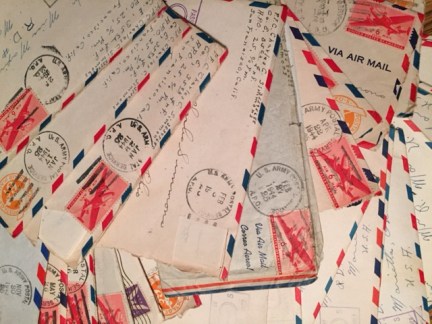
Until I found her in a box of old letters.

Letters

In 1944, Elizabeth was living in Ohio with her husband, raising two children and devoting her time to her home and family, like most women of her generation.  Her eldest daughter had already married and moved a few hours away.  Elizabeth was probably still adjusting to this change, one of her chicks leaving the nest.  But Betty was safe.  She was happy.  She was protected and she was loved.  Elizabeth missed Betty, but she knew that Betty was okay.

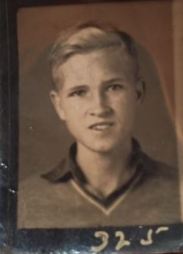
Her eldest son, Charles Jr., however, was another story.  The distance between Elizabeth and her son did not escape her.  She could never, not even for one moment, take his safety for granted.  Every joy was tempered by her worry that Charles might be cold or hungry, depressed or homesick, or, worse yet, injured or imprisoned.

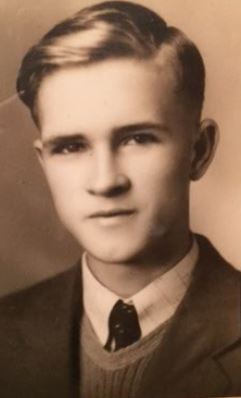
Charles had enlisted to serve in the United States military.  Somewhere far away, on the other side of the globe even, he was fighting in World War II.  Her heart was so proud of his selfless courage, but it was equally crushed by the weight of her fears for the safety of her son.

Portrait Closeup

Elizabeth listened to radio broadcasts and read newspaper articles about the developments during the war, but what was happening on the frontlines still seemed distant.  News was not instant, and the images were static.  Life at home continued, as normally as possible.  She had teenagers to care for, Lewis and Maxine, and her daily routines helped to keep her occupied.

And she had letters.

Charles wrote regularly, and Elizabeth wrote to him often, as well, sending packages to remind him how much he was missed.  He enjoyed her gifts, like the peanuts she sent that he shared with his friends and fellow soldiers.  Occasionally, he asked her to send specific things that he needed, and she always obliged.  He shared funny stories, like the time that a deer sneaked into the barracks and ate all of the snacks, and he told her about the Abbott and Costello movie that they had watched for entertainment.  His letters were upbeat and positive.  War didn’t sound so scary at all.

Letters from Charles never mentioned danger.  They never described exactly what he was assigned to do or even where he was.  He mentioned that he censored his letters so that they would be approved to leave the base, leaving Elizabeth to wonder what he was omitting.  He often looked forward to the day he would come home, and he always signed off with the same encouraging closing: “Thumbs up!”

As the oldest boy in the family, Charles was full of advice, especially for his younger brother, Lewis.  Even from across the globe, he advised Lewis about girlfriends and class schedules.  He told Lewis to keep his options open with the ladies, even though Charles himself was clearly sweet on one young lady, Doris, whose name was mentioned frequently in his letters.  He asked Lewis to send him pictures so that he could stay connected to what was happening at home.  He told Lewis what classes he should take in high school and was clearly disgusted, even in the midst of war, when his little brother did not take his advice.

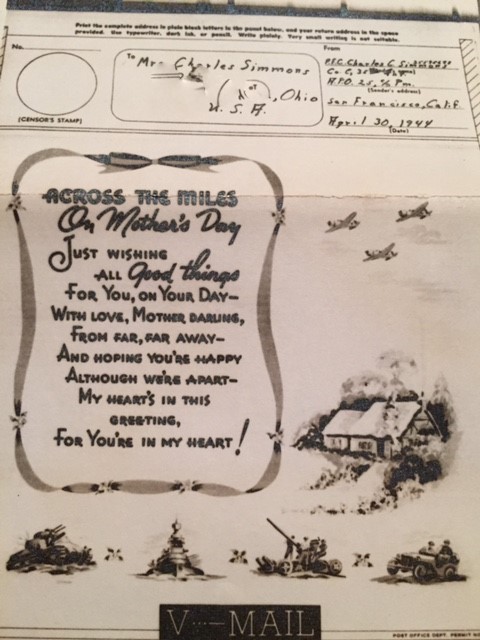
Charles was thoughtful, as well, remembering his mother on important dates throughout the year.  He must have known how much she worried about him.  His Mother’s Day message in 1944, so simple and plain, was the most beautiful Mother’s Day gift that Elizabeth could have received while he was gone.  Her tears, as clear as glass, left no stains on the precious letters from her son overseas, letters that she opened oh-so-carefully.

Mother's Day

Elizabeth must have read her Mother’s Day note a thousand times before safely tucking it away in the box where she kept all of Charles’ letters.  Gently touching that paper, running her fingers across his ink on the page, was the closest that she could come to embracing her son.  To the world, these men in uniform were so strong and so brave.  But to her, Charles was so very young, hardly a man himself, really.  Just a few years before, he had still needed her advice, her reassuring touch, her loving care.  She had gently washed and bandaged his skinned knees not all that long ago.  Yet now he and so many young men like him had been entrusted to save the world.

Charles Closeup

Days and months passed, and Charles remained at war.  Elizabeth was comforted by his letters, but sometimes there were long spans between them, and this made her nervous.  If she waited long enough, another letter always came.  It would include an apology for the long delay, explaining that he had been quite busy with his responsibilities, although exactly what his duties were was a bit of a mystery.  Each letter provided some  solace, but Elizabeth knew that by the time she received it, time had already passed, and the reassurance of his safety was actually old news.  As soon as one note was received, she eagerly awaited the next.

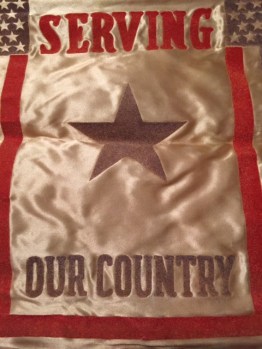
In the meantime, Elizabeth loyally supported her son from afar.  She hung a  banner in the family’s front window for everyone to see and took Maxine’s picture in front of it.

Flag  Flag in Window

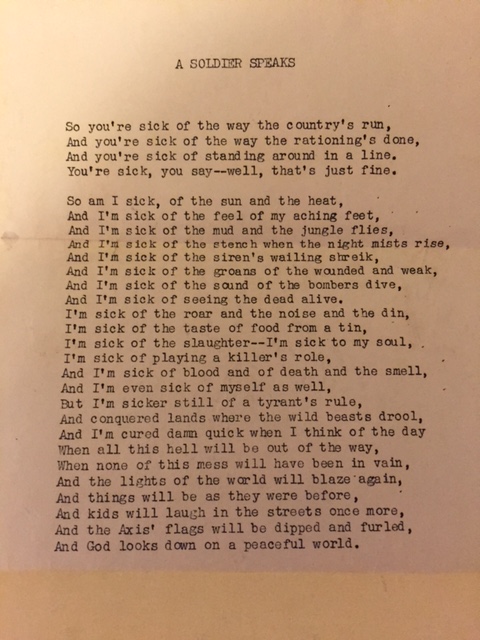
And she clung to a poem (author unknown) that criticized the discontent of those who weren’t directly in the line of fire.  How dare someone complain about rationing when her son’s life was on the line?

Poem

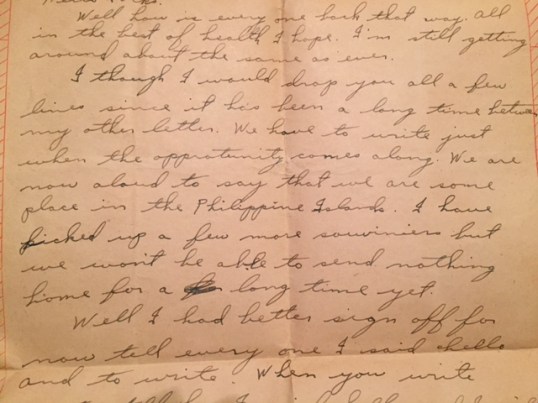
In January 1945, Elizabeth received a letter with a little more information than usual.  Charles’ letters had been few and far between for a while now, but in this one he shared, “We are now allowed to say that we are someplace in the Philippine Islands.”  What a relief it was to know where her son was actually located!  She could point to it on a map.  She could imagine the climate and the scenery where he was.  “I have picked up a few more souvenirs,” he said, although he explained that he wouldn’t be able to send them for a while.  Someday, she thought, they would look at those souvenirs together, and he would tell her interesting stories about the culture and the merchants there and how much he had paid for the beautifully crafted and exotic gifts.

In Phillipines

As always, Charles had asked for more letters.  Over the previous months, their letters, flying back and forth across the sky and over the ocean, had created an invisible web that kept them connected, mother and son.  Even when there was nothing to write about, Elizabeth kept writing.  She would write and write and write, about nothing and about everything, until she could finally see Charles face to face once more.

And there, in the bottom of the box, I found them.  The two letters, stamped March 19, 1945 and April 16, 1945.

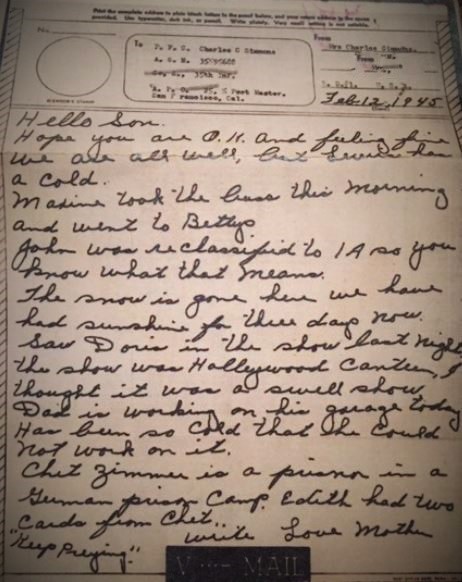
In the first envelope, Elizabeth had neatly tucked a letter full of updates for her son.  The news from home was nothing out of the ordinary.  Lewis has a cold.  Maxine recently visited Betty.  The snow has melted, and Doris performed well in the show last night.

But the war still loomed like a dark cloud over the small town in Ohio.  Charles, of course, was abroad.  There was concern that John could be drafted after being reclassified to 1A.  And Chet, another local boy, was being held captive in an enemy prison camp.  “Thumbs up” was now “Keep praying.”

Return to Sender Close

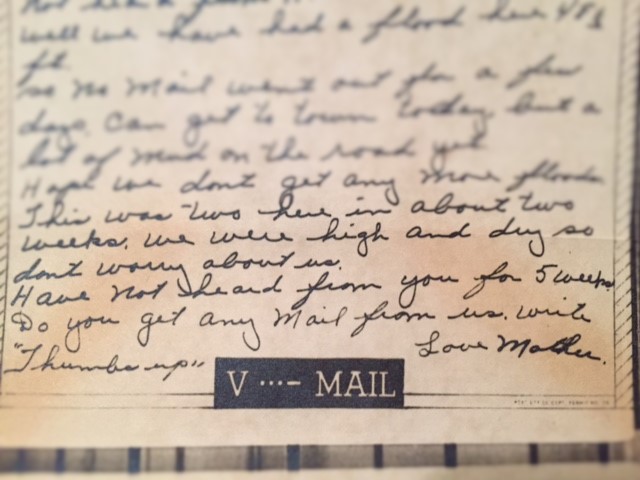
And then there was a second letter from Elizabeth, a letter mailed in March of 1945.  Elizabeth wrote about the recent flooding in the area and how the mail had been delayed.  There wasn’t much to share, really.  The news at home was mostly uneventful.   The letter was a bit mundane.

But then, the ending.  A simple statement that was dripping with emotion.

“Have not heard from you for 5 weeks . . . Write.  Love, Mother.”

And their standard closing, “Thumbs up.”

Five Weeks

And something in my stomach turned, and my throat tightened at the thought of Elizabeth’s anguish, her desperate wait for a response.  The sadness rushing to my eyes threatened to interrupt the story when I realized that here, in this box full of letters from Charles, I was holding two letters from Elizabeth.  Two love letters from a mother to her son.  Two letters that she had mailed to the Philippines.

Two letters that should not be in this box of mail that she had received.

Two letters that confirmed that what she had always feared had come true.

The Elizabeth that I knew lived in a nursing home.  She was elderly and frail.  I don’t remember seeing her stand or even sit up.  I remember her as a tiny, fragile lump beneath the covers.  Her lips were dry, and her words were mumbled, and she was hard for me to understand.

My mother said that something tragic had happened to Elizabeth once.  She said the people closest to Elizabeth claimed that she had never been the same again.  But my mother loved Elizabeth; she had fond memories of her grandmother.  For me, at five-years-old, my great-grandmother and I had nothing in common.  Elizabeth, to me, was lost.

Until I met Elizabeth, a young mother of sons, just like me, a mother who loved courageously and prayed steadfastly and hoped fiercely for the well being of her greatest treasures, her children.

Until I found her in a box of old letters.

We often associate love stories with courtship and romance, but maybe, just maybe, there is no greater love story than the love between a mother and her son.

My Top Five Post Picks

Wow!  Choosing my top five posts of the first year was harder than I expected!  The first three choices were easy.  There was no question what those first three would be.  But the last two picks were harder.   I wrestled with questions, like how do you pick a favorite child, anyway?  What makes one post better than another?  How did I feel when I was writing each piece?  How much of me was invested in each one?  Does the number of readers who liked each post matter, and, if so, how much?

There were several close runners-up, including this post about my nephew’s cute fishing story and this one about developing “real” relationships with our friends.   And then there were posts that started conversations and made a difference to people, like “A Letter To My Son’s Soccer Coach” and “Yes, I’m a Christian.  No, I’m Not Like That.”  However, the posts that I chose as my top 5 are posts that are so close to my heart that all kinds of hidden emotions start swirling when I read them.  You can click on the infographic below to go to the “live” version.  It has links that will take you to any of the posts that you want to revisit! (Aren’t these infographics FUN?!?!?)

top-5-favorite-posts-on-still-chasing-fireflies (3)

Now it’s your turn!  I REALLY want to hear about your favorite posts on Still Chasing Fireflies in the past year.  Please comment, here or on Facebook or both.  Let’s create a conversation.  Thanks for chasing fireflies with me this year!

~Mary Ann